 Gas Safe Registered
Smart Thermostat Norwich


Smart thermostat installation across Norwich and the surrounding NR postcodes, by Gas Safe registered engineers. Google Nest, Hive, tado and other mainstream systems. Fitted for homes, for landlords, and for the older terraces where the wiring makes it awkward.
Registered Engineers
Response
Service Available
Wide Coverage
Boiler Point installs smart thermostats across Norwich and the surrounding NR postcodes. A smart thermostat lets you control your heating from your phone, run a proper schedule, heat rooms separately, and see what the system is actually doing. We fit the mainstream, well-supported systems — Google Nest, Hive and tado among them — and we are not tied to any one brand. All work is carried out by Gas Safe registered engineers. Call 01493 295 064.
What a smart thermostat is worth to you depends on the property. Below we have set out where it genuinely pays in Norwich — and where, honestly, it does not.
Norwich Landlords and HMOs: Heating a Property You Do Not Live In
Norwich has one of the larger private rented sectors in the region — the UEA belt around NR4 and Earlham, the professional flats in the city centre, and the terraced HMOs across the Golden Triangle. If you own one of those, the heating problem is not comfort. It is that you are paying for, or responsible for, a system you cannot see.
A smart thermostat changes that. You can hold a schedule, set an upper temperature limit, and look at the app to see whether the heating is running in an empty property in August. In a shared house it settles the perennial argument about the thermostat by taking it off the wall entirely.
It also protects the property between tenancies. Frost protection can be left running at a low set point over a void period, so an empty student house in NR4 does not sit through a January cold snap with the heating off entirely.
A note on the law: a smart thermostat is a tool for cutting waste, not for rationing. You still owe your tenant a property that can be adequately heated, and remote controls do not change that.
Smart Thermostat Installation, Start to Finish
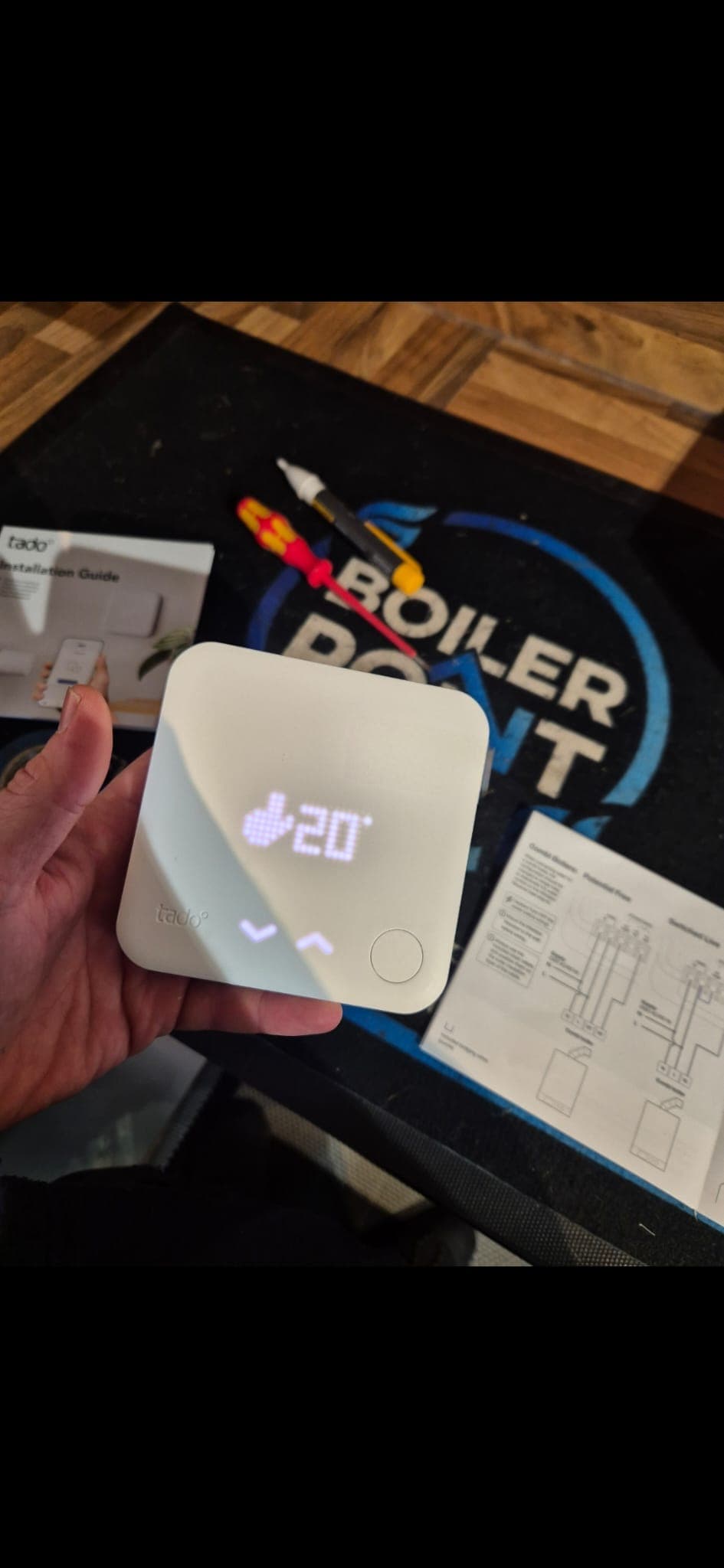
Our engineers fitting and commissioning a smart heating control
Victorian Terraces and Conservation Areas in NR2
A large part of central Norwich — the Golden Triangle, the streets off Unthank Road, Christchurch Road, parts of Thorpe Hamlet — is Victorian and Edwardian terracing, and much of it sits in a conservation area.
For a smart thermostat, the conservation designation itself is not an obstacle: it restricts external alterations, and a thermostat is entirely internal. It matters if you are also planning a boiler replacement, where flue positions and external pipe runs can be restricted.
What genuinely complicates these houses is the fabric and the wiring:
A typical Norwich terrace has a single heating zone and one thermostat, usually in the hall — the coldest, draughtiest spot in the building. So the boiler runs to satisfy the hall while the front bedroom cooks. Smart radiator valves let you set each room independently without touching the plumbing.
Nobody wants to chase new cable through lath-and-plaster or a solid brick wall. Wireless thermostats with a receiver wired at the boiler avoid that entirely, which is why we normally recommend them for these properties.
Solid walls lose heat steadily rather than suddenly. Weather compensation — where the system reads the outside temperature and adjusts the flow accordingly — suits that behaviour much better than a blunt on/off thermostat.
A 1980s wiring centre behind a Victorian airing cupboard is often the actual obstacle. We check it before quoting, because that determines whether this is a one-hour job or a three-hour one.

Off the Gas Grid: Oil and LPG in the Villages
Once you are past the ring road, mains gas thins out fast. Taverham, Drayton, Brundall, Poringland and much of NR9, NR10, NR13 and NR14 are full of properties running on oil or LPG.
That changes the arithmetic. When you buy fuel by the tankful, waste is not an abstract percentage on a monthly bill — it is the delivery you have to order sooner than you planned. Tighter scheduling, zoning and weather compensation have a more direct, more visible impact on an oil-heated property than on a gas one.
Smart thermostats work with oil boilers in the same way they work with gas: the control switches the boiler, and it does not care what is burning inside it. We check the wiring and the existing controls first.
What It Will Actually Save You
The Energy Saving Trust estimates that smart heating controls can cut heating bills by up to 10-20%. That is an upper figure, and it is worth understanding where it comes from before you budget around it.
A smart thermostat does not make your boiler more efficient. It saves money by stopping you heating rooms and hours you did not need to heat. So the size of the saving depends entirely on how much waste there is to remove:
- Big saving likely: a large house heated as one zone, an irregular schedule, a system that runs all day so one room is warm in the evening, or a let property nobody is watching.
- Modest saving likely: a small, well-insulated home with a sensible programmer already set and someone who actually uses it.
We would rather tell you that up front than have you expect twenty per cent and get four. If the honest answer for your property is that the payback is slow, we will say so.
What the Installation Involves
Assessment
We check the boiler, the wiring centre and the existing thermostat, and confirm what the property will take. This is where the surprises get found — before you have bought anything.
Choosing the system
Nest, Hive, tado or another mainstream control, chosen on what your system needs — single zone or multi-zone, heating only or heating and hot water, wired or wireless.
Isolation and removal
Power is safely isolated and the old thermostat and controls are disconnected.
Wiring and integration
The new control and its receiver are wired in, with any adapters or rewiring the system needs. On older Norwich properties this is usually the longest part of the job.
Commissioning and testing
Power restored, system tested end to end on heating and hot water, and the app paired to your Wi-Fi.
Setup and handover
We set your schedule up with you, show you how the app works, and leave you the documentation. If you are a landlord, we can hand it over set up and locked to your schedule.
A straight swap for an existing wired thermostat is typically 45 to 90 minutes. A touchscreen model, a hot water channel or a system needing new wiring is usually 2 to 3 hours. Zoning a whole house with smart radiator valves takes longer.
Smart Heating Controls: What You Get
Scheduling, zoning, weather compensation and remote control, explained
Where We Install Smart Thermostats Around Norwich
Golden Triangle & city centre
NR1, NR2 — Unthank Road, Christchurch Road, Thorpe Hamlet
UEA & the student belt
NR4, NR5 — Earlham, Eaton, Bowthorpe, Cringleford
North Norwich
NR3, NR6 — Catton, Sprowston, Hellesdon
East Norwich
NR7 — Thorpe St Andrew, Heartsease, Dussindale
Off-grid villages
NR8, NR9, NR10, NR13, NR14 — Taverham, Drayton, Brundall, Poringland
Boiler Point is based in Great Yarmouth, around twenty miles from Norwich, and covers the city and the surrounding villages. A thermostat installation is planned work rather than an emergency, so it is booked to a date that suits you. Landlords with several Norwich properties can have them fitted on the same visit where they are close enough together.
Book a Smart Thermostat Installation in Norwich
Tell us the property — a terrace off Unthank Road, a let house near the UEA, an oil-heated cottage out at Brundall — and we will tell you what will actually work in it. Book online or call 01493 295 064.
Norwich Smart Thermostats
Best Suited To
• Landlords and HMOs around the UEA
• Large houses heated as a single zone
• Victorian terraces with one hall thermostat
• Off-grid oil and LPG village properties
• Households with irregular schedules
Key Features
Other Services in Norwich
Landlord? Talk to Us First
If you let one property or ten around Norwich, tell us what you are trying to control and we will tell you which system does it — and whether it is worth it.
Call: 01493 295 064
Smart Thermostats in Norwich: Common Questions
Ready to Get Started?
Contact us today for a free, no-obligation quote. Our Gas Safe registered engineers are ready to help.
Serving Great Yarmouth, Norwich, Lowestoft, and all of Norfolk