 Gas Safe Registered
Power Flush Norwich


Central heating power flushing across Norwich and the surrounding NR postcodes. We clear magnetite sludge, rust and debris that leave radiators cold at the bottom, make the boiler kettle and push up your gas bill. Gas Safe registered engineers. Price agreed before we book.
Registered Engineers
Response
Service Available
Wide Coverage
Boiler Point carries out central heating power flushing across Norwich and the surrounding NR postcodes. A power flush in Norwich costs £300 to £600, depending on the number of radiators, the size of the system and how much sludge we find, and we agree the price with you before the appointment is booked. All work is carried out by Gas Safe registered engineers. Call 01493 295 064.
A power flush pushes a high volume of water and cleaning chemicals through your heating system at pressure, dislodging the magnetite sludge, rust and debris that have settled inside the radiators, the pipework and the boiler. It is not a magic fix for every heating fault — but where the symptoms are sludge, it is the only thing that actually clears it.
Why Norwich Heating Systems Sludge Up
Two things work against a heating system in Norwich, and most of the city has both.
The pipework is old. The terraces around the Golden Triangle, Unthank Road, Christchurch Road and Thorpe Hamlet are Victorian and Edwardian. Many still run heating on pipework that has been patched, extended and part-replaced across a century of owners. Old steel pipe corrodes from the inside, and the iron oxide it sheds is what magnetite sludge actually is. Narrow, aged, awkwardly routed pipe is exactly where it settles.
The water is hard. Norfolk sits on chalk, so Norwich is a hard water area. That adds limescale to the picture, and scale and sludge tend to accumulate in the same restricted spots — the heat exchanger, the pump, the bottom of the radiators. It is why we see kettling boilers and cold-bottomed radiators across the city year after year.

Do You Actually Need a Power Flush?
Plenty of heating problems get blamed on sludge when they are something else entirely. These are the symptoms that genuinely point to it.
The single most reliable sign of sludge. Magnetite is heavier than water, so it settles in the base of the radiator and blocks the flow across the bottom. If it is cold at the top instead, that is air, and it just needs bleeding.
Clean system water runs clear or slightly cloudy. Black, gritty water is iron oxide — the system is corroding internally and depositing the result in your pipework and boiler.
Restricted flow through the heat exchanger causes water to overheat and boil locally. In Norwich the hard water makes this worse, because limescale and magnetite build up in the same restricted places.
Sludge narrows the bore of the pipework. Everything still works, it just works slowly, and you burn more gas holding the house at the same temperature.
A boiler that keeps faulting and needs resetting is often protecting itself from poor circulation. Replacing parts on a sludged system just moves the failure along to the next component.
If none of that sounds like your system, a power flush is probably not what you need. We would rather diagnose the actual fault than sell you a flush that will not fix it.
What a Power Flush Actually Involves
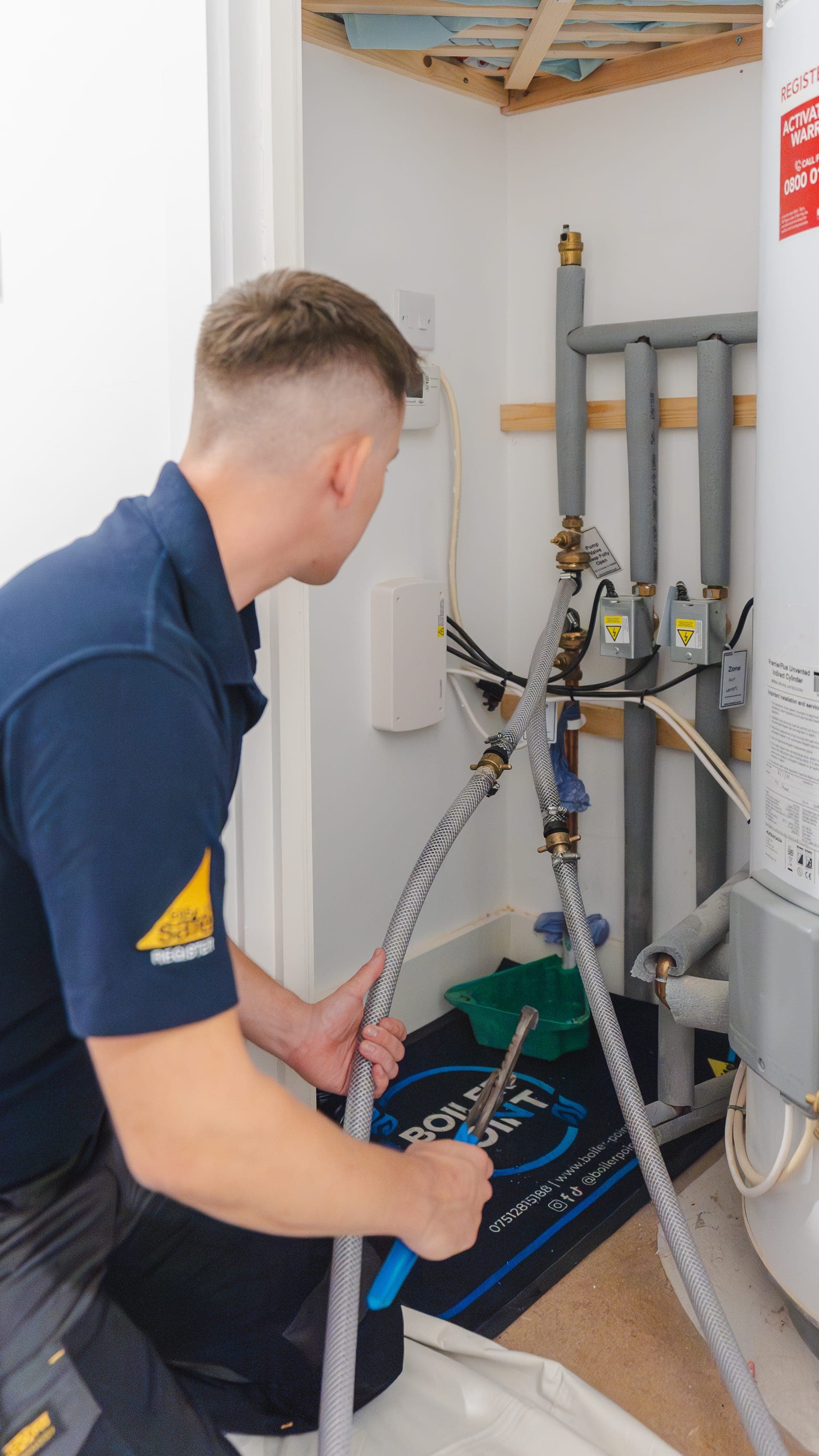
Our engineers running a full power flush on a domestic heating system
Power Flushing Before a New Boiler in Norwich
If you are replacing a boiler in an older Norwich property, this is the part worth reading. Boiler manufacturers generally require the heating system to be cleaned before a new boiler is commissioned — and fitting a new boiler onto a system full of magnetite can invalidate the warranty on the boiler you have just paid for.
The reason is straightforward. A modern condensing boiler has a far narrower heat exchanger than the cast-iron units it replaces. Sludge that an old boiler tolerated for twenty years will block a new one in a season. A century-old terrace off Unthank Road, with original pipework and radiators that have never been cleaned, is the textbook case.
- System cleaned and flushed before the new boiler is commissioned
- Inhibitor added afterwards so the system does not start corroding again
- Magnetic filter recommended where the pipework is old — it catches what comes loose later
- Written record of the flush for your warranty file
Power Flush or MagnaCleanse? Which Your System Needs
Full power flush
High-velocity pumps and cleaning chemicals driven through the whole system at pressure, radiator by radiator. The heavier job, and the only one that shifts serious build-up.
Right when:
- Radiators are cold at the bottom or dead entirely
- The boiler kettles or keeps locking out
- The system has never been cleaned and the pipework is old
- A new boiler is going on afterwards
MagnaCleanse
A magnetic filter unit captures iron oxide as the system water circulates. Quicker, gentler and less disruptive, but it will not clear a genuinely blocked system.
Right when:
- Build-up is moderate and caught early
- The system is fragile and a full flush risks disturbing old joints
- You are maintaining a system that was flushed previously
On the oldest Norwich properties this judgement matters. Century-old pipework can be delicate, and driving a full flush through joints that have not been touched in decades occasionally finds a weak one. We look at the system first and tell you honestly which of the two it needs — or whether it needs neither. More on MagnaCleanse.

The Equipment We Bring to a Norwich Power Flush
We use Clearflow power flushing equipment — high-velocity pumps and magnetic filtration that pull the iron oxide out of the water rather than just pushing it around the system.
- High-velocity pumps, with flow reversed through each radiator in turn
- Magnetic filtration capturing magnetite as it is dislodged
- You see the water that comes out — no need to take our word for it
- Inhibitor dosed at the end so the system does not immediately re-corrode
Where We Power Flush in and Around Norwich
Golden Triangle & city centre
NR1, NR2 — Unthank Road, Christchurch Road, Thorpe Hamlet
North Norwich
NR3, NR6 — Catton, Sprowston, Hellesdon, Mile Cross
East Norwich
NR7 — Thorpe St Andrew, Heartsease, Dussindale
South & west Norwich
NR4, NR5 — Eaton, Cringleford, Earlham, Bowthorpe, Costessey
Surrounding villages
NR8, NR9, NR10, NR13, NR14 — Taverham, Drayton, Brundall, Poringland
Boiler Point is based in Great Yarmouth, around twenty miles from Norwich, and we work across the city and the villages beyond the ring road. A power flush is a planned half-day job, not an emergency call-out, so it is booked in rather than squeezed in.
What Happens on the Day
- System inspected and each radiator checked, so we know what we are dealing with
- Flushing unit connected, usually at the pump or a radiator tail
- Cleaning chemicals circulated to break down sludge, scale and corrosion
- Each radiator flushed individually with the flow reversed, to lift settled magnetite
- System flushed through with fresh water until it runs clear
- Corrosion inhibitor added to protect the system going forward
- Heating rebalanced and tested, and the work left clean and tidy
Allow 4 to 6 hours for an average home. Bigger systems, or heavily sludged ones, take longer — and we will tell you that before we start, not halfway through.

Book a Power Flush in Norwich
Tell us what the system is doing — which radiators are cold, whether the boiler is noisy, whether the bleed water runs black — and we will tell you whether a power flush is the right answer. Book online or call 01493 295 064. The price is confirmed before anyone travels.
Norwich Power Flush
Signs of Sludge
• Radiators hot at top, cold at bottom
• Black water when bleeding
• Boiler kettling or banging
• Radiators slow to heat
• Repeated boiler lockouts
• Rising gas bills for the same heat
Norwich Areas Covered
• Golden Triangle & Unthank Road
• Thorpe Hamlet & Thorpe St Andrew
• Eaton, Cringleford & Earlham
• Sprowston, Catton & Hellesdon
• Costessey, Bowthorpe & Taverham
• Drayton, Brundall & Poringland
Other Services in Norwich
Power Flushing in Norwich: Common Questions
Ready to Get Started?
Contact us today for a free, no-obligation quote. Our Gas Safe registered engineers are ready to help.
Serving Great Yarmouth, Norwich, Lowestoft, and all of Norfolk