 Gas Safe Registered
Power Flushing in Great Yarmouth


Central heating power flushing across Great Yarmouth, Gorleston and the surrounding NR30 and NR31 postcodes. We are based here. Cold radiators, noisy pipes and black water when you bleed a rad all point to sludge — and a flush is what clears it. Price agreed before we book.
Registered Engineers
Response
Service Available
Wide Coverage
A central heating power flush in Great Yarmouth costs £300 to £600, takes four to six hours, and is the fix for cold spots at the bottom of your radiators, banging pipes and black water when you bleed a rad. Boiler Point is based in Great Yarmouth— we flush systems across NR30, NR31, Gorleston and the surrounding villages, and we agree the price before we book. Call 01493 295 064.
A power flush drives high-velocity water and cleaning chemicals through every radiator and pipe run in the system, lifting out the iron oxide sludge, rust and scale that has settled over the years. What comes out is black. What goes back in is clean water, inhibitor, and — if you do not already have one — a magnetic filter to stop it happening again.
Why Great Yarmouth Systems Sludge Up
Old seaside pipework.The Victorian and Edwardian terraces around the town centre, Southtown and Gorleston have systems that have been patched, extended and part-replaced over decades. Steel radiators corrode from the inside, and the iron oxide they shed settles as sludge in the coolest, lowest part of the system — which is why the bottom of the radiator goes cold while the top stays hot.
Hard water. Norfolk sits on chalk. Great Yarmouth is a hard water area, and limescale deposits combine with that sludge to restrict flow through the heat exchanger and the narrow pipe runs.
Systems that stand idle.A large slice of the housing stock here is holiday lets, B&Bs, guest houses and park homes. A system that sits unused for months, then gets run hard for a season, silts up faster than one that ticks over all year. Standing water is where sludge settles and pumps seize.

Do You Actually Need a Power Flush?
Not every heating problem is sludge, and we would rather tell you that than sell you a flush you do not need. These are the symptoms that genuinely point to a contaminated system.
The classic sludge signature. Sludge is heavier than water and settles in the bottom of the radiator, so the heat cannot reach it. If bleeding the radiator does not fix it, the problem is not air — it is sludge.
Clear water is fine. Brown or black water is iron oxide — your radiators corroding from the inside. That debris is circulating through your boiler.
Restricted flow and a scaled heat exchanger make the boiler noisy when it fires up. On the hard water we have here, kettling is one of the most common complaints we get called out to.
Usually the ones furthest from the boiler, or the ones upstairs in a converted loft. A blocked pipe run or a seized valve starves them of flow.
Restricted circulation makes the boiler overheat and lock out on safety. Repeated lockouts with no obvious fault often trace back to a dirty system rather than a failing boiler.
Manufacturers require the system to be cleaned before a new boiler is commissioned. Fitting a new heat exchanger onto an old sludged system can void the warranty on day one. This is the single most common reason we flush a system in Great Yarmouth.
A Power Flush, Start to Finish
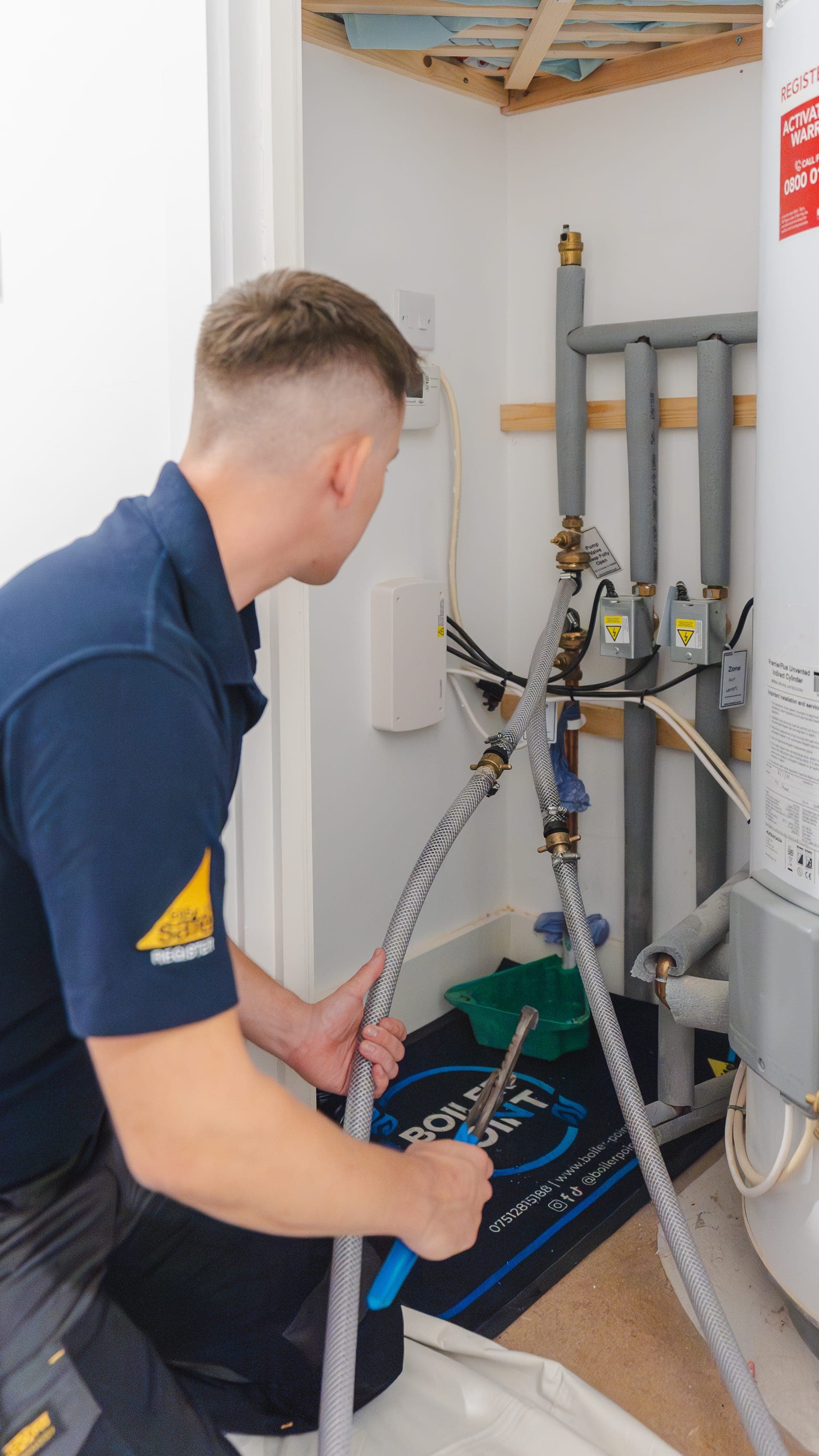
Our Gas Safe engineers walk through a full power flush on a domestic system
Flushing Before a New Boiler: Not Optional
If you are having a new boiler fitted in Great Yarmouth, the condition of the existing system matters as much as the boiler you choose. Most manufacturers — Worcester Bosch, Vaillant, Ideal and Baxi among them — require the heating system to be cleaned to the relevant standard before the boiler is commissioned. Skip it and you can invalidate the warranty on a boiler that is a week old.
That is not a technicality. A new condensing boiler has a narrow, high-efficiency heat exchanger. Push years of accumulated sludge from an old system through it and you will block it — and the manufacturer will not pay to put it right.
- We assess the system condition at the installation survey, not on fitting day
- If it needs a flush, it goes on the quote up front with a price attached
- We fit a magnetic system filter and dose the system with inhibitor as part of every installation
- Where pipework is too old or fragile for an aggressive flush, we will say so and recommend a MagnaCleanse instead
New boiler installations in Great Yarmouth run £2,000 to £4,000 fitted. See our Great Yarmouth boiler installation page for what that includes.

Holiday Lets, Guest Houses and Seasonal Systems
Great Yarmouth's seafront and Gorleston have a large holiday let, B&B and guest house economy, and those heating systems live a strange life: months of standing still, then a season of being run flat out by guests who leave the heating on all day.
That pattern is hard on a system. Sludge settles in standing water, pumps and valves seize from disuse, and the first cold snap of the season is when you find out — usually with paying guests in the building.
The answer is to flush and protect the system out of season, in the shoulder months, so the heating is proven before your first booking. We can also fit a magnetic filter and set up a servicing schedule that fits around your letting calendar rather than fighting it.
Power Flush or MagnaCleanse? Which Your System Needs
We offer both, and they are not interchangeable. Which one is right depends on how bad the contamination is and how old the pipework is — a real consideration in the older terraces here.
Full power flush
High-velocity pumps and cleaning chemicals driven through every radiator and pipe run, using professional Clearflow equipment. The most thorough option, and the one that shifts severe, long-standing sludge and corrosion.
Right for:
- Severe cold spots, persistent noise, repeated boiler lockouts
- Systems that have never been cleaned
- Preparing an older system for a new boiler
MagnaCleanse
A powerful magnetic filter captures iron oxide as the water circulates. Quicker, gentler and fewer chemicals — which matters when the pipework is old enough that an aggressive flush could find a weak point and turn it into a leak.
Right for:
- Moderate build-up, or preventative maintenance
- Older or fragile pipework in period properties
- A quicker, less disruptive clean
We assess the system before we quote and tell you which one it actually needs. If it needs neither, we will tell you that too.
Professional Clearflow Equipment
We use industry-standard Clearflow power flushing machines — not a DIY kit and not a hose on a garden tap. The pump reverses flow through each radiator in turn and the magnetic filtration captures the debris as it comes out, so you can see exactly what was in your system.
- High-velocity, flow-reversing cleaning pumps
- Magnetic filtration — you see the sludge come out
- System dosed with inhibitor and refilled clean
- Magnetic system filter fitted where you do not already have one

Where We Power Flush Around Great Yarmouth
Great Yarmouth town
NR30 — town centre, Marine Parade & seafront, Southtown, Cobholm, North Denes, Runham
Gorleston & the south
NR31 — Gorleston-on-Sea, Bradwell, Belton, Burgh Castle, Hopton-on-Sea
The coast north of town
Caister-on-Sea, Scratby, Hemsby, Ormesby, Martham
Inland & the Broads edge
Acle and the villages between Yarmouth and the Broads — gas, oil and LPG systems
Great Yarmouth is our home patch — the business is based here, so a job in NR30 or NR31 is a local job, not a trip out.
We work on gas, oil and LPG systems, which matters once you head inland towards Belton, Burgh Castle and the villages where mains gas runs out.

Book a Power Flush in Great Yarmouth
Book online, or call 01493 295 064 and we will assess the system, confirm whether it needs a full power flush or a MagnaCleanse, and agree the price before anyone travels.
Great Yarmouth Power Flush
Signs You Need a Flush
• Cold at the bottom of the radiator
• Black water when you bleed a rad
• Banging, gurgling or kettling pipes
• Radiators that never get warm
• Boiler locking out repeatedly
• New boiler going on an old system
Areas Covered
• Great Yarmouth town & seafront
• Southtown, Cobholm & Runham
• Gorleston-on-Sea & Bradwell
• Belton, Burgh Castle & Hopton
• Caister-on-Sea, Scratby & Hemsby
• Ormesby, Martham & Acle
Other Services
• Boiler installation in Great Yarmouth
• MagnaCleanse in Great Yarmouth
• Boiler servicing & repairs
• Landlord safety certificates
Power Flushing in Great Yarmouth: Common Questions
Ready to Get Started?
Contact us today for a free, no-obligation quote. Our Gas Safe registered engineers are ready to help.
Serving Great Yarmouth, Norwich, Lowestoft, and all of Norfolk